MALSE.DEV
COGNIS NEXUS — The Cognitive Runtime
Governance, memory, and judgment for AI agents — evaluated before execution, not explained after.
> nexus.evaluate confidence=0.80 risk=elevated
> policy.gate requires_approval
> verdict escalate → human
> override.present scope=WRITE_INTERNAL ok
> audit.write entry signed · hash-chained
In plain terms: the AI shows its work and asks permission before doing anything costly — and keeps the receipts.
The runtime is live at api.malse.dev — access is gated. Credentials issued to design partners under NDA.
Core capabilities
Pre-execution governance
Every consequential agent action is evaluated before it runs. Allow, escalate, require approval, or block — with the reason recorded.
Episodic memory
Outcomes persist across sessions. Agents stop repeating the mistakes your logs already paid for.
Multi-agent coordination
Shared belief state across agent fleets. Conflicts surface before they become actions.
Tamper-evident audit
Every decision is recorded in a hash-chained, verifiable log. Answer 'why did the agent do that?' after any incident — with proof.
The MALSE™ Framework
Grounded in five cognitive capability families that shape observable agent behavior.
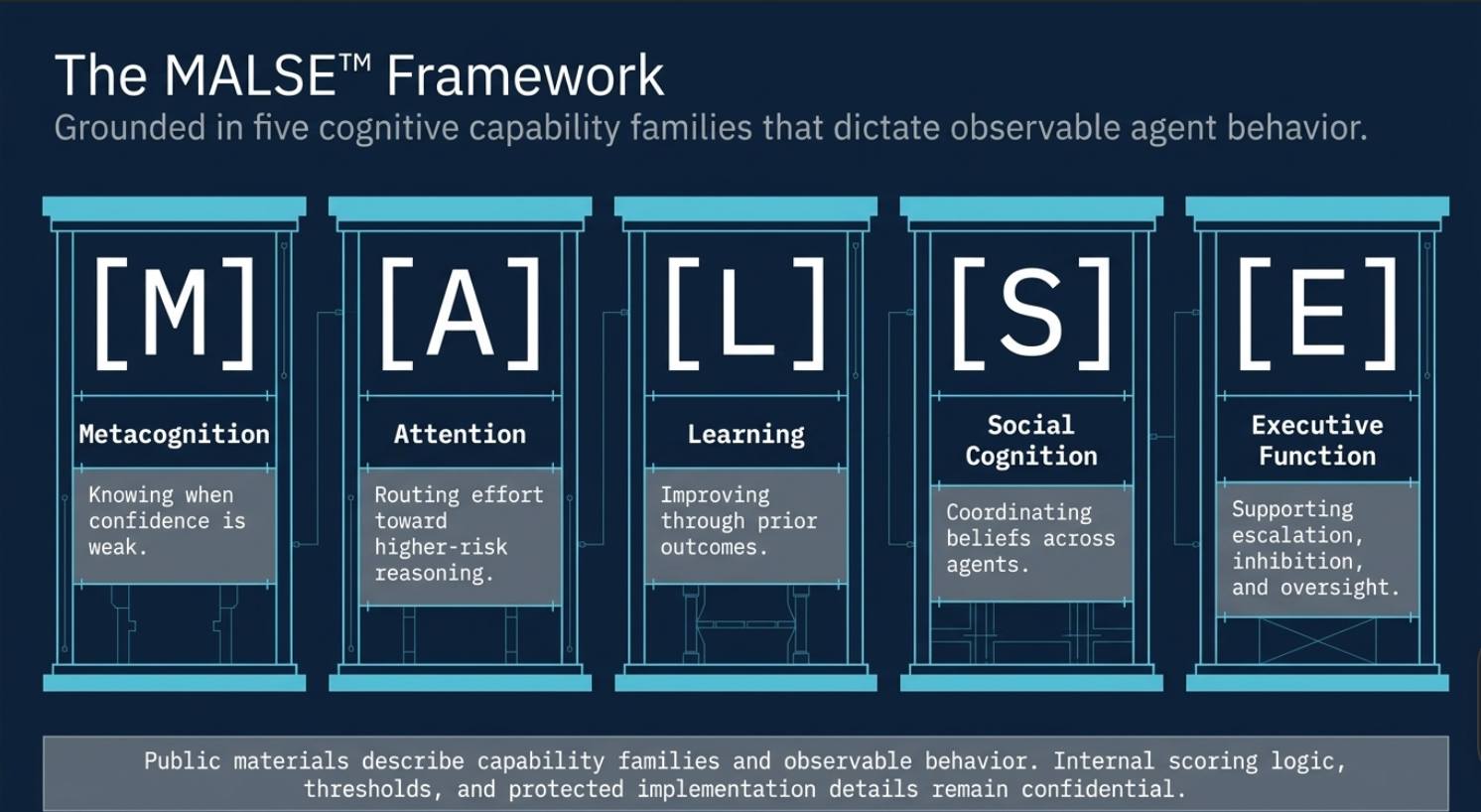
Public materials describe capability families and observable behavior. Internal scoring logic, thresholds, and protected implementation details remain confidential.
WHY A COGNITIVE RUNTIME
Models make agents capable. RAG makes them informed. Neither makes them accountable.
Enterprises should train capable models and connect them to trusted knowledge. But when an agent can change a customer account, issue a refund, deploy software, move data or delegate work, better answers are not the same as controlled execution. COGNIS NEXUS adds independent decision assurance before consequential actions proceed.
Model training
Improves the model's general capability and behavior. It does not independently verify whether a specific action is justified.
RAG and knowledge bases
Provide relevant and current context. Retrieved information can still be incomplete, stale, contradictory or misapplied.
Identity and secure execution
IAM establishes who may act. Sandboxes and secure runtimes constrain where actions execute. These controls remain essential.
COGNIS NEXUS
Provides a separate runtime assessment of whether available evidence supports a proposed action and routes uncertainty for review. Records decision evidence and connects realized outcomes to future assurance.
These layers complement one another. COGNIS NEXUS does not replace the model, RAG, IAM or execution isolation.
When does an enterprise need NEXUS?
NEXUS is a strong fit when
- Agents can execute customer, financial, operational or compliance-sensitive actions.
- Multiple models or agent frameworks need consistent oversight.
- Uncertain decisions must be escalated before execution.
- Review teams need to focus on the decisions that matter most.
- The organization must reconstruct who acted, what evidence was considered and why the action proceeded.
- Organizations can connect realized outcomes to future assurance without retraining every underlying model.
RAG and application controls may be enough when
- The AI only drafts low-risk, reversible internal content.
- A human reviews every output before anything happens.
- Fixed deterministic rules fully describe the decision.
- No portable decision evidence or multi-agent identity is required.
- The organization is comfortable building and maintaining its own assurance layer.
The business case grows with the authority given to the agent and the cost of a wrong autonomous action.
Agent security is becoming a full-stack discipline.
NVIDIA's July 27, 2026 announcement of the Open Secure AI Alliance reflects a broader industry shift toward full-stack agent security — identity, permissions, harnesses, guardrails, logs and evaluation across the full operating stack.
COGNIS NEXUS is a model-agnostic cognitive runtime focused on decision assurance, escalation, evidence and outcome learning. It complements identity systems, policy engines and secure execution environments rather than replacing them.
Which agent action would your organization never allow without evidence?
Start with one consequential workflow. We will map its identity, evidence, review, execution and outcome requirements — and determine whether a cognitive runtime is justified.
Built and operated by AI Sync System Inc. — a British Columbia company (BC1539132). Validated on NVIDIA NIM. Public materials describe observable behavior only; scoring logic, thresholds, and internals remain confidential.
MCP-native — agents connect through the Model Context Protocol, not a bespoke SDK.